HYPERPRIOR

HyperPrior Research

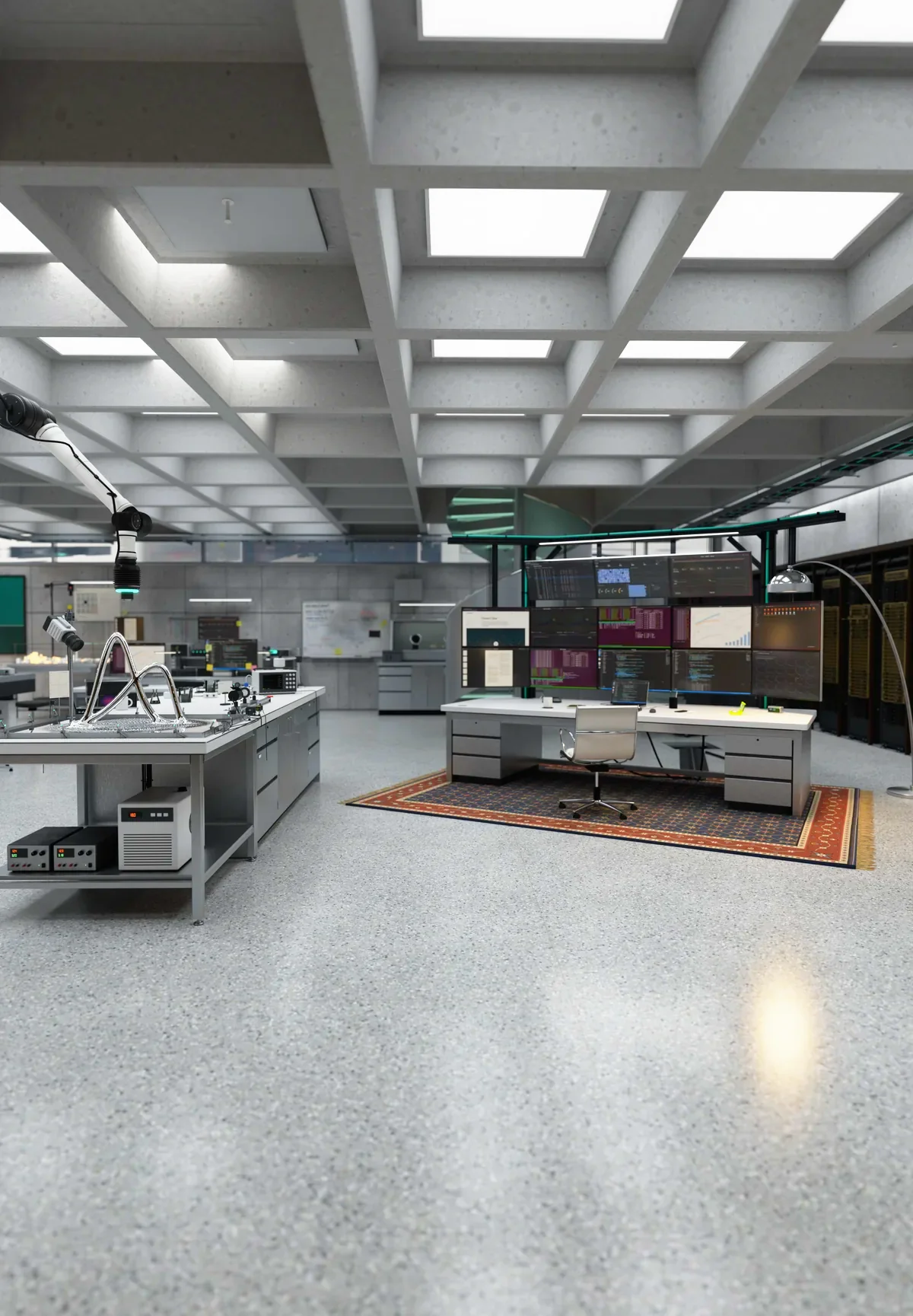
The laboratory at night, seen from the reception it opens off. At the left is a long bench, where the mark of the house stands in a tray of liquid metal under the head of an arm hung from the ceiling. At the right is the lead’s station, a heavy desk on an old rug under a bank of displays, with racks of computers along the wall beyond it. A stair turns up to the floor above, under a ceiling of concrete coffers.

Definition

hy·per·pri·or /ˈhaɪ.pəˌpraɪ.ə/ n.

  1. 1. stats. A belief spread over the priors one might start from.
  2. 2. A small, privately funded research group in London. We build world simulators and execution environments for learning agents, and study complex adaptive systems. On occasion we selectively work with external organisations facing difficult technical decisions.

See origin, also prior, posterior, calibration, hyperparameter, common prior

Research agenda

Our research sits where reinforcement learning, economic and systems simulation, and data and information physics meet. We build simulators, verifiers and pretraining corpora on our own cluster. We study what emerges when search and policy gradients push a simulator or a learned world model to its limits.

Research interests subject to change without notice. Beliefs likewise.

Instruments and commissions

Alongside our own research, we occasionally build and hand over training infrastructure for frontier labs and technical organisations.

Who we are

We are a small, interdisciplinary team of researchers and engineers, drawn from trading firms and AI labs, who like to understand and build complex systems.

We work across machine learning, statistics, economics and computer science. Much of our background is in the plumbing of global markets, where incentives are sharp and mistakes are expensive. Years in that world taught us what happens when strong optimisers meet a flawed rulebook. Training models against environments poses the same engineering problem.

HyperPrior Research was founded in London in 2022 and is privately funded, with no outside money and its own compute. It is led by Patrick Steele, who read computer science at the University of Auckland, holds an MBA from Cambridge and spent more than a decade in systematic and quantitative trading, most recently at DRW.

We work from Shoreditch, a short walk from Bunhill Fields, where Thomas Bayes now rests.

We are currently hiring. Please take a look at Positions if you are interested in collaborating.

Contact

Write to us to scope a custom simulator, verifier or pretraining build, or to ask about our research.

If you build simulators, compilers or training pipelines, please check out our open positions.

HyperPrior Research

Data sheet

Definition

hy·per·pri·or /ˈhaɪ.pəˌpraɪ.ə/ n. ハイパープライアー

  1. 1stats. A belief spread over the priors one might start from.
  2. 2A small, privately funded research group in London. We build world simulators and execution environments for learning agents, and study complex adaptive systems. On occasion we selectively work with external organisations facing difficult technical decisions.

Origin From the Greek hyper, over, and the Latin prior, earlier. A prior on a prior, and so a way of writing down how sure one is about how sure one is.

See also prior, posterior, calibration, hyperparameter, common prior

prior stats. A probability distribution over an unknown quantity, written down before the data are seen.

posterior stats. The distribution over an unknown quantity after the data are seen, which is the prior updated by the evidence.

calibration stats. The agreement between how confident forecasters say they are and how often their forecasts prove right.

hyperparameter stats. A parameter of a prior distribution, which a hyperprior in turn treats as uncertain.

common prior games. The assumption that the players’ beliefs all come from one prior, so that they differ only in what they have seen. Harsanyi used it to recast a game with incomplete information as a game with complete information that opens with a chance move. Aumann showed that under it two people whose posteriors are common knowledge cannot agree to disagree. A hyperprior is what you write down instead.

Research agendaResearch areas

Calibrated Void if overconfident. Brier ≤ 0.25

Our research sits where reinforcement learning, economic and systems simulation, and data and information physics meet. We build simulators, verifiers and pretraining corpora on our own cluster. We study what emerges when search and policy gradients push a simulator or a learned world model to its limits.

01πEnvironments and verifiersHow do you build a verifier that holds up under heavy optimisation?
02∫Pretraining data and synthetic tracesWhat must a base model have read for reinforcement learning to work?
03ΣLong-horizon credit assignmentWhich step in a thousand-step rollout actually earned the outcome?
04∇Economic and multi-agent dynamicsWhat emerges when policies learn inside an economy of other adapting agents?
05∂Sim-to-real transfer and holdoutsWhen does optimisation in an approximate world transfer to ground truth?

Papers and research areas

Research interests subject to change without notice. Beliefs likewise.

Instruments and commissionsCommissions

Alongside our own research, we occasionally build and hand over training infrastructure for frontier labs and technical organisations.

01Execution environmentsDeterministic sandboxes and simulators for code, proofs and markets.
02Adversarial verifiersTests and judges that hold up against reward hacking.
03Pretraining corporaVerified synthetic data, token pipelines and holdout decontamination.
04Private holdoutsUncontaminated evaluation suites that stay off the public web.

Terms

Scope
A pilot simulator, a verifier, a world-model evaluation, or a full training pipeline
Compute
Built and red-teamed on our cluster, or inside yours when your data cannot leave
Delivery
Source code, deterministic containers, test suites and ablation reports
Discretion
Mutual NDA by default, and nothing built for one lab is reused for another

Who we are

We are a small, interdisciplinary team of researchers and engineers, drawn from trading firms and AI labs, who like to understand and build complex systems.

We work across machine learning, statistics, economics and computer science. Much of our background is in the plumbing of global markets, where incentives are sharp and mistakes are expensive. Years in that world taught us what happens when strong optimisers meet a flawed rulebook. Training models against environments poses the same engineering problem.

HyperPrior Research was founded in London in 2022 and is privately funded, with no outside money and its own compute. It is led by Patrick Steele, who read computer science at the University of Auckland, holds an MBA from Cambridge and spent more than a decade in systematic and quantitative trading, most recently at DRW.

We work from Shoreditch, a short walk from Bunhill Fields, where Thomas Bayes now rests.

We are currently hiring. Please take a look at Positions if you are interested in collaborating.

Devices

HPR-C1 calling card and its HPR-R1 reader, HPR-C2 calibrator, HPR-C3 communicator.

Registration

HyperPrior Research Ltd, registered in England and Wales, No. 14046272.

Shoreditch, London

Write through the communicator at hyperprior.net/contact.

The communicator needs JavaScript to open. Without it, write to the registered office, which is under Legal & privacy.

Printed from hyperprior.net. Deliberately partial.

Bayes, Thomas /beɪz/ (c.1701–1761)

Presbyterian minister at Tunbridge Wells and Fellow of the Royal Society from 1742. His essay on the doctrine of chances, which gives the rule that carries his name, was read to the Society in 1763, after his death, by his friend Richard Price. He is buried in Bunhill Fields on City Road, a few minutes from this group’s desks.

See hyperprior

Keys

The site’s keyboard shortcuts, on a printed slip. Press Escape to close.

?
This slip
Esc
Close whatever is open
j, k
Next and previous row in a list
Enter
Open the row, or go through the card
F
Turn over the calling card, the slab or the communicator
Space
Hold the room’s tour and let it go, with its picture in focus
W, A, S, D
Walk, in the room
Y, N
Yes and No, on the calibrator
Arrows
How sure, on the calibrator
Hold Enter
The calibrator’s self test

Words you can type on the home page

calibrate opens the calibrator, bayes opens a second entry.