Commissions
We build the environments, verifiers, pretraining data and private tests that a lab’s training runs depend on.
What we build
A training run usually runs out of environment, reward or data before it runs out of compute. Public benchmarks leak into pretraining sets within months, and a learned judge is gamed once a strong policy leans on it. We build those parts to hold and hand them over as source and containers.
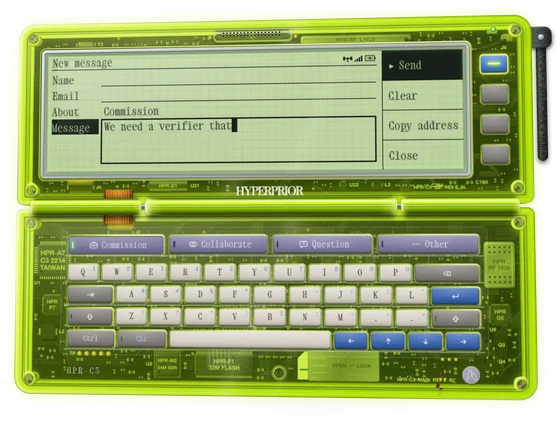 Tell us what your run runs out of first.
Contact us
-
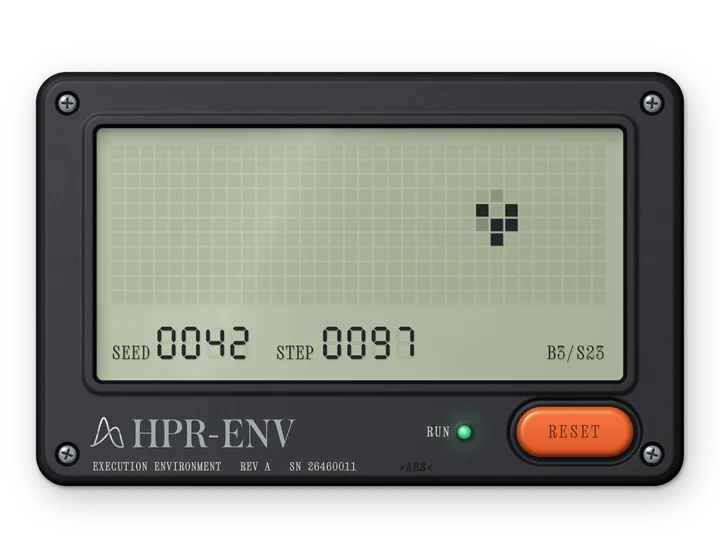
HPR-ENV HPR-ENV
Execution environments
Sandboxes and simulators where a model edits repositories, uses tools, proves theorems or trades in a market. The same seed gives the same run. Episodes reset to a known state without leaking files, processes or network state.
Specifications
Containerised environments built for asynchronous rollout throughput, isolated at the syscall and network namespace. Bit-exact seeded replay, state snapshots for mid-episode branching, and economic simulators whose accounts balance exactly.
-
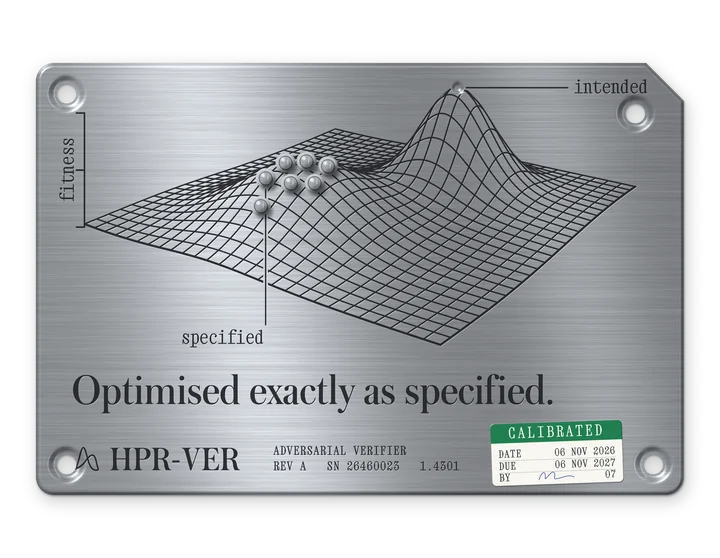
HPR-VER HPR-VER
Adversarial verifiers
The tests and judges that turn a model’s output into a training signal. Before handover, we run search and RL policies against the verifier itself to find and close the loopholes a model could exploit for reward.
Specifications
Executable outcome checks, property-based test suites, syntax-tree and syscall trace inspection, and learned judges calibrated against ground truth. For world models, we replay plans in bit-exact simulators and score logged rollouts before RL runs start.
-
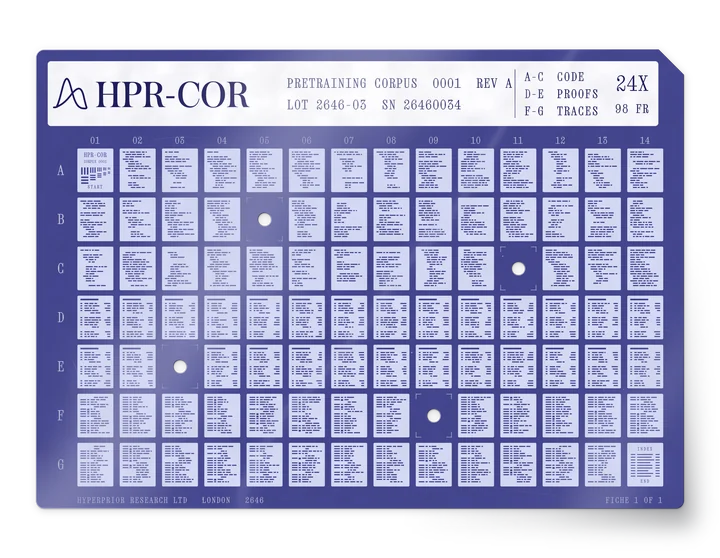
HPR-COR HPR-COR
Pretraining corpora
Data pipelines for pretraining, mid-training and cooldown runs. Code is executed and proofs are checked before a token is kept, and the corpus is scrubbed against your evaluation sets so benchmark leaks do not pass for progress.
Specifications
Tokenised pipelines of execution-checked code, formal mathematics and counterfactual reasoning traces. We run exact and semantic decontamination against your holdouts and set mixture weights with cooldown ablations. The ablation reports ship with the data.
-
HPR-HLD HPR-HLD
Private holdouts
Test suites built from scratch and never published, used to decide whether a checkpoint is ready. A generator produces fresh task instances from parameters, so a model cannot pass by memorising a fixed problem set.
Specifications
Parameterised task generators, deterministic verifiers and a sealed harness that keeps the instances inside it. Procedural seeds separate pass-at-k gains from training-set contamination and measure generalisation outside the training distribution.
Typical commission terms
- Scope
- A pilot simulator, a verifier, a world-model evaluation, or a full training pipeline
- Form
- An ongoing programme or a one-off delivery
- Compute
- Built and red-teamed on our cluster, or inside yours when your data cannot leave
- Delivery
- Source code, deterministic containers, test suites and ablation reports
- Discretion
- Mutual NDA by default, and nothing built for one lab is reused for another
- Commercial
- Price, timeline and ownership agreed per commission
How we maintain signal integrity
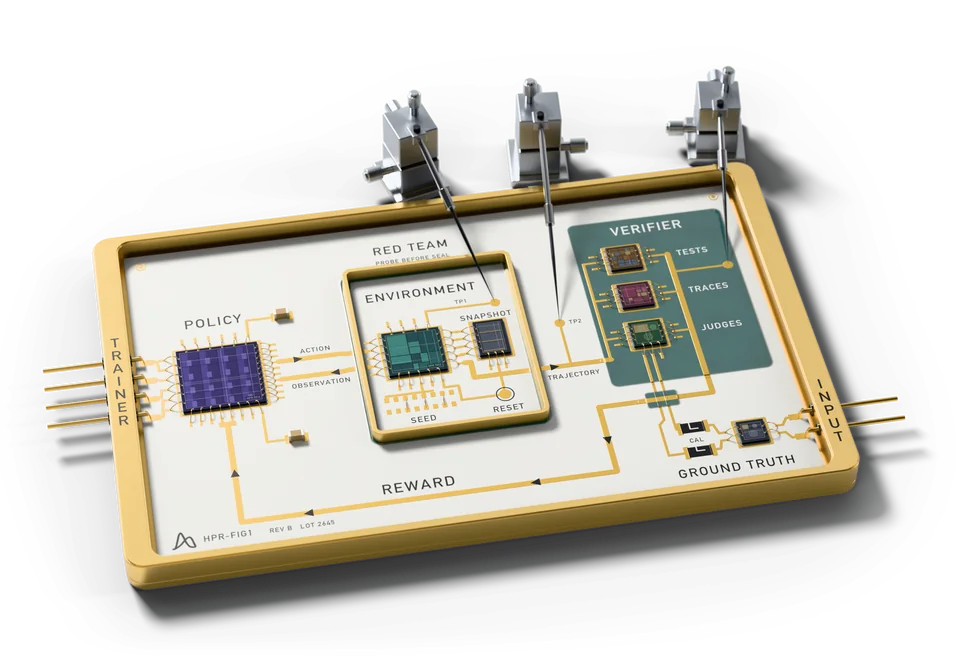
- Policy The model in training. It acts in the environment and learns from the reward.
- Environment A seeded sandbox that snapshots its state, isolates syscalls and network, and resets cleanly between episodes.
- Verifier Tests that execute, checks on syntax trees and syscall traces, and calibrated judges, which together score the outcome.
- Reward The verifier’s score, passed back to the trainer.
- Ground truth Formal checks and human labels, used to calibrate the judges and to spot drift.
- Red team Search and adversary policies run on our cluster or yours before handover. They look for ways to game the verifier.
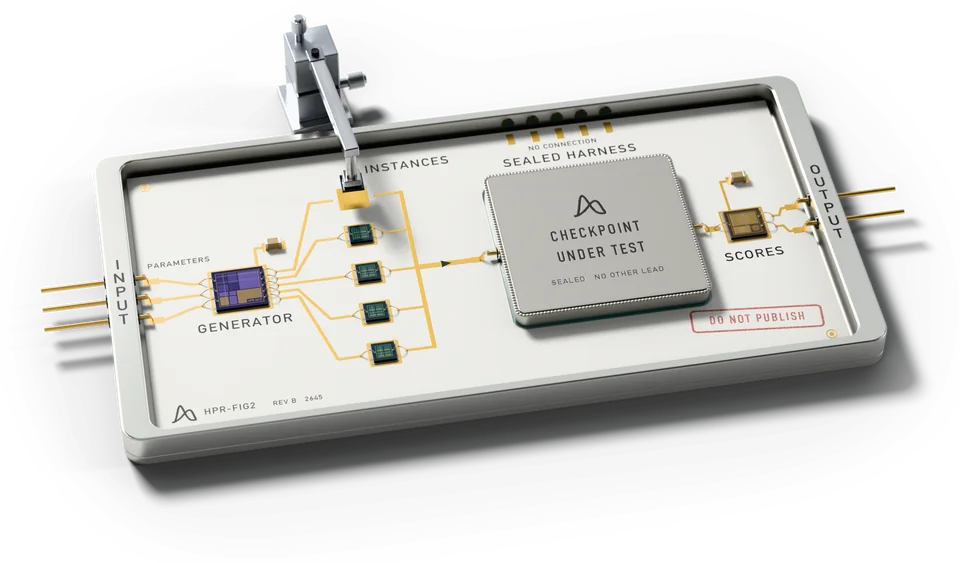
- Generator Builds task instances from parameters, so there is no fixed list of problems to leak.
- Instances Drawn fresh for an evaluation run, so a checkpoint cannot have memorised them.
- Sealed harness Runs the checkpoint on the instances. Nothing inside it leaves.
- Scores Pass-at-k with contamination ruled out, and performance outside the training distribution.
- Off the public web Written from scratch for one lab and never published.
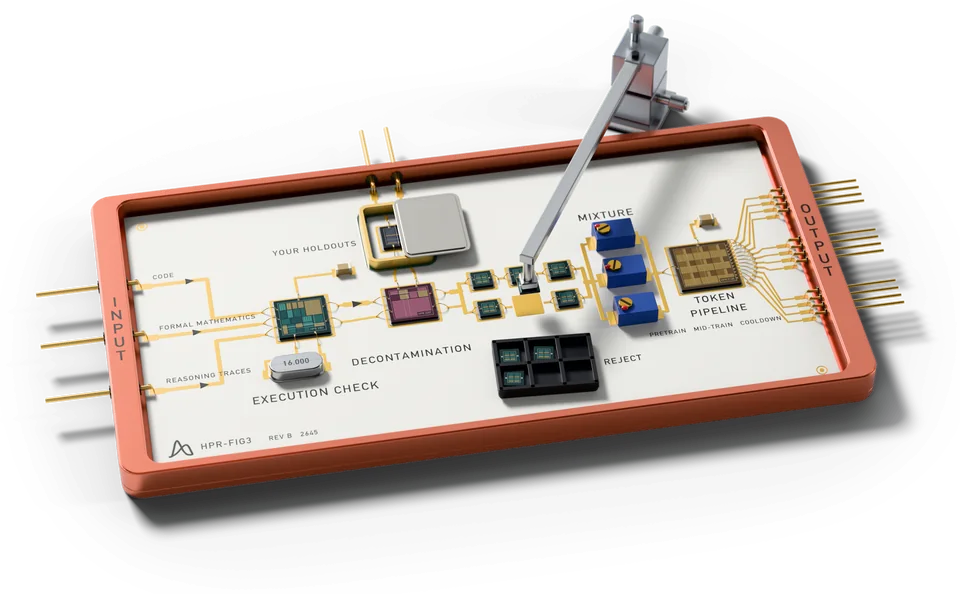
- Sources Code repositories, formal mathematics and counterfactual reasoning traces.
- Execution check Code is run against its tests and proofs are verified before a trace is kept.
- Decontamination Exact and semantic matching removes whatever overlaps your evaluation holdouts.
- Mixture Weights set by cooldown ablations. The ablation reports come with the corpus.
- Token pipeline Tokenised shards for pretraining, mid-training and cooldown runs.
Next steps
- Write. A note through the communicator, under Commission.
- Scope. A conversation, then a written scope.
- Pilot. A pilot simulator or verifier check, where it fits.
- Build. On our cluster or yours.
- Red team. Red-teamed and ablated before handover.
- Handover. Source, containers, tests and reports.
- Commission a build
- Data sheet PDF, 2 pages
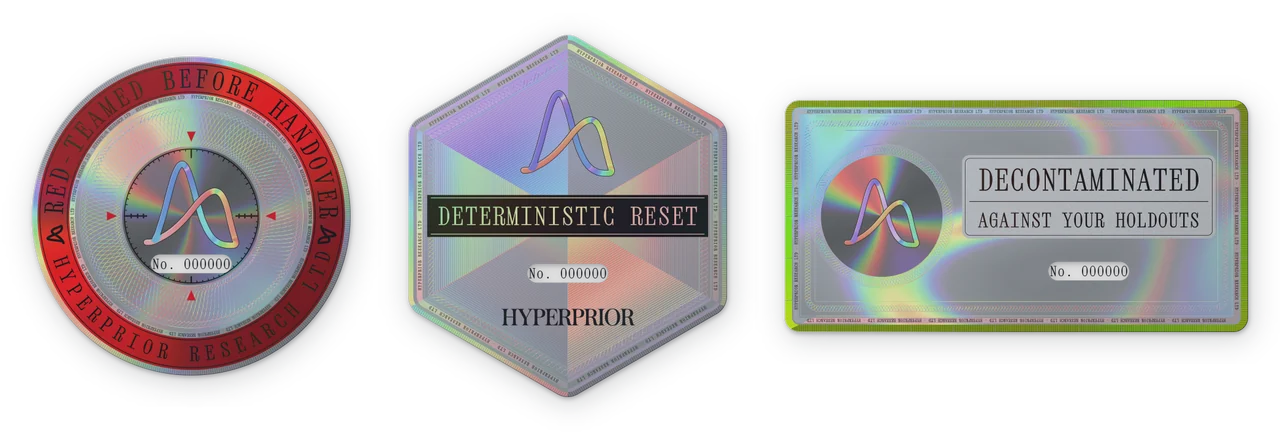
Nothing ships from our lab until all three hold.
- Red-teamed before handover
- Deterministic reset
- Decontaminated against your holdouts